
Author Archives: ACT

Registration now open for PBS in Schools Conference

This two day conference will feature a number of presentations focused on the use of PBS strategies in the school environment with children with special needs. Read more on the event page!

Keynotes:

Practical Ways to Decrease Challenging Behaviors in School, Home, and Community Settings with Dr. Lynn Kern Koegel, Stanford University, California

PBS – Working Together to Support Children and Families with Dr. Ilene Schwartz, University of Washington

More details on PBS in Schools Conference are coming soon. Sign up for our mailing list to get the latest on the schedule, panels, and discounts.

News Round-Up April 2018 Edition

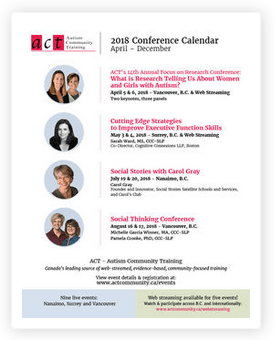
Registration Open for Three New Events!

Non-Aversive Strategies to Assist Individuals with Autism and Challenging Behaviours

Friday, August 24
Vancouver, BC, & Web Streaming!

Andrew McDonnell, PhD, Director of Studio3 Training Systems, UK

This one-day workshop will focus on how to manage behaviours of concern using a low arousal approach, developed by Dr. McDonnell to help personnel in schools and group homes manage ‘highly aroused’ and stressed individuals. The emphasis will be on verbal and nonverbal strategies to de-escalate crisis situations. In addition, the approach involves ‘reflective practice’ that is, ‘What is my own contribution to the situation? Low-arousal approaches include interaction, diffusion and distraction strategies; coping with challenging behaviours including debriefing – why it is necessary and how to do it, managing versus changing behaviours, physical avoidance skills and physical intervention strategies. Event Details & Registration


Managing the Anxious Symptoms of Children and Adolescents with ASD: Practical Strategies

Thursday & Friday, September 27 & 28
Vancouver, BC

Judy Reaven, PhD, Associate Professor of Psychiatry and Pediatrics, University of Colorado

Children and adolescents with ASD are at high risk for developing anxiety symptoms that interfere with functioning at home, school and in the community. Research has shown that children and teens with ASD and anxiety demonstrate significant reductions in anxiety following participation in modified Cognitive Behavior Therapy (CBT) interventions. Facing Your Fears (FYF) is a group CBT intervention for managing anxiety in youth with ASD. Throughout the training, participants will learn about FYF, identify core components of the clinic based FYF program, learn how to modify FYF for teens with ASD and intellectual disabilities, as well as strategies for delivering FYF in school settings. Video examples and interactive small group activities will occur throughout the training

Event Details & Registration


INVESTing in Girls and Women with ASD
Friday, November 2nd
Vancouver, BC & Web Streaming!

Dori Zener, MSW, RSW

Girls and women with ASD largely camouflage their characteristics in an effort to pass as neurotypical. Due to their difficulties reading social cues, girls and women with ASD are disproportionately victims of bullying, sexual assault and abusive relationships. Mental health challenges such anxiety, depression, panic, eating disorders, ADHD, OCD and addictions often come to the attention of professionals before an ASD diagnosis is given, if at all.

INVEST: Identify Needs, Validate, Educate, Strengthen and Thrive has been developed by Dori Zener based on her extensive clinical experience with women and girls with ASD.

Event Details & Registration


More upcoming events

Cutting Edge Strategies to Improve Executive Function Skills 2018
May 3 & 4, 2018 – In-person seats sold out! Web Streaming spots available

Social Stories with Carol Gray
July 19 & 20, 2018 – Nanaimo

Introduction to ASD – Practical Applications – POPARD
July 30 – August 3, 2018 – Surrey
October 29 – November 2, 2018 – Vancouver

Social Thinking Conference with Michelle Garcia Winner
August 16 & 17, 2018 – Vancouver

Register for 2 events and save $50.
Use coupon code 50off2 at checkout or contact ACT.
Valid for both in-person and web streaming registration.
Coupon cannot be combined with other discounts or bursaries.
 

Bursaries for those most in need, including para-professionals, parents who have children with special needs, adults with ASD, and professionals who need to travel outside of their home regions are also available, to the best of our financial ability. Bursaries are also available for webstreaming – internationally and Canada!
For information on how to apply for an ACT bursary, please visit the Bursaries FAQ page


Printable guides for Events, Videos, and the Autism Information Database

Visit the links below to view our PDF guides to ACT Events, Autism Videos @ ACT, and the Autism Information Database.


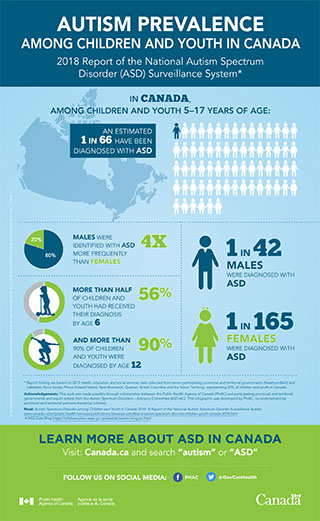
Autism Prevalence among Youth in Canada – A Report of the 2018 National ASD Surveillance System

Recorded at ACT’s 14th Annual Focus on Research Conference
Presented by Professor Anthony Bailey, Chair of Child and Adolescent Psychiatry, University of British Columbia

Dr. Anthony Bailey’s presentation of the 2018 National ASD Surveillance report is now available, free, on Autism Videos @ ACT. In this video, Professor Bailey, Chair of Child and Adolescent Psychiatry at UBC, provides an insightful overview of the epidemiology of  ASD in Canada. After discussing the methodology used to develop the NASS Report, Dr. Bailey presents a summary of the findings and compares Canada’s rate of ASD among children and youth, to the situation internationally.
Watch on Autism Videos at ACT


Awareness and Acceptance are Only the Start

Editorial by Dr. Anthony Bailey

April is Autism Awareness Month in most of Canada. For the first time, with the publication by the Public Health Agency of Canada of “ASD Among Children and Youth in Canada 2018”, Canadians have a comprehensive snapshot of autism in Canada. What lies ahead for the 1 in 66 children affected by ASD in Canada as they enter adulthood? Because of inclusive educational policies, today’s’ Secondary School graduates will likely have had at least some contact with an individual with ASD. But improved awareness about ASD has not translated into significant improvements in adult outcomes. Indeed, we need look no further than post-secondary education to see how much still needs to be done.

View the full article


How You Can Support Improving the Employment Prospects of Youth and Adults with ASD

It is very tough to attract research funding for practical projects focused on the needs of youth and adults. A group of researchers at the University of British Columbia, led by Dr. Bailey, have set up an innovative 12-week group workshop to help adults with ASD succeed in higher education and the workplace but they need funding to proceed. To see how you can help, visit the crowdfunding page.


Remembering Michael Price

ACT is saddened to share with the autism community that a long serving volunteer, Michael Price, has died. Michael was a founding member of ACT’s Board of Directors and contributed greatly to our community and our organization for many years. We extend our condolences to his wife Katrina and his three children. We will remember Michael as a kind and collaborative person who not only worked to understand the needs of his own son, but gave selflessly of his time to benefit the community as a whole.


Autism in the News

Get the latest on ACT’s Facebook page

Munson: Here’s what a national autism strategy can do – Ottawa Citizen

A Disproportionate Number of Autistic Youth Are Transgender. Why? – Slate

We grew up not knowing we were autistic – BBC News

I Am Autistic – This Is What The World Looks Like To Me – Huffington Post UK

Drowning death of Saskatoon boy with autism preventable: children’s advocate – Global News

Author Speaks Out After Learning She Has Autism at 45: ‘I Finally Knew Why I Was Different’ – People

‘He’s doing a lot better today’: Here’s what happened when autistic Brampton boy got lost on a field trip – Brampton Guardian

‘I am absolutely furious,’ says mother trying to renew disability tax credit – CBC News

I’m autistic, here’s how to be friends with me – The Daily Telegraph

Four ways to support girls with autism – TES

I have ‘High Functioning Autism’ – but what does it really mean? – Metro UK

Magazine names Channel-Port aux Basques most autism-friendly town in Canada – CBC News

How to help autistic children socialise in school – The Conversation

‘The uniform and the rules attract autistic people to join the police’ – BBC News

Seven things parents of kids with special needs hate, and seven ways to be supportive – The Washington Post

The most autism-friendly town in Canada – Maclean’s

What An Autism Spectrum Friendly Environment Can Teach Us About Good Management – Forbes

Parents of children with autism announce plan to take legal action against government – CBC News

School autism project improving attendance and changing lives of children, families – Australian Broadcasting Corporation

On disability, Twitter is better late than never – CNN

How do you make a destination autism-friendly? – CTV News


Awareness and Acceptance are Only the Start

April is Autism Awareness Month in most of Canada. For the first time, with the publication by the Public Health Agency of Canada of “ASD Among Children and Youth in Canada 2018”, Canadians have a comprehensive snapshot of autism in Canada. What lies ahead for the 1 in 66 children affected by ASD in Canada as they enter adulthood? Because of inclusive educational policies, todays’ Secondary School graduates will likely have had at least some contact with an individual with ASD. But improved awareness about ASD has not translated into significant improvements in adult outcomes. Indeed, we need look no further than post-Secondary education to see how much still needs to be done.

The Bad News

Individuals with ASD have the lowest rates of university enrollment of all the disabilities and have less chance of graduating than their typically developing peers. In between, bright individuals under-perform, many students are socially isolated, and struggles with independent living are common. These difficulties often arise because students are ill-prepared for College or University life. Most will have received no targeted help in adolescence with the social-communication skills necessary for adult success, and the complexity of higher education can overwhelm individuals who have not been taught work arounds for difficulties with organisation and time management. Addressing these gaps may require changes to the Secondary School curricula for pupils with ASD, or the development of new post-Secondary transition courses targeting specific skills.

Individuals with ASD have the lowest rates of university enrollment of all the disabilities and have less chance of graduating than their typically developing peers.

Some Good News

Encouragingly, Colleges and Universities, have made big improvements in their support for students with all disabilities. Help and accommodations are now more easily available and successful peer mentoring schemes for students with ASD have also been established. But there are still significant challenges. Frequently there are not enough resources to provide proactive and targeted psychological support. Moreover some people choose not to disclose their ASD diagnosis for fear of stigmatisation. Also up to a third of adult students with ASD start post-Secondary education without a diagnosis and may not know why things are not going well. Indeed, ASD is particularly underdiagnosed in girls and women, and overall the condition is often not identified until an individual’s mental health deteriorates.

High Mental Health Needs Requires the Engagement of Medical Professionals Broadly

In fact neurodevelopmental disorders, such as ASD, show strong associations with mental illness and adults with ASD can sometimes be more impaired by Anxiety, Depression or Obsessive Compulsive Disorder than by their social-communication difficulties. We now know that enabling adults with ASD to lead productive and fulfilling lives critically depends on identifying and successfully treating these other conditions, which previously may have been overlooked. But significantly improving mental health in the ASD population will require a shift in perceptions: ASD is now so common that diagnosis and management can no longer be the preserve of specialists. The challenges are in identifying ways of efficiently educating health professionals about a childhood onset condition that persists into adult life, and ensuring that health systems properly factor adult ASD into service planning.

Encouragingly, Colleges and Universities, have made big improvements in their support for students with all disabilities.

Employment is Key

A major incentive for rethinking adult services is the sizable bill to taxpayers. ASD is usually thought about in a childhood context, but in fact 90% of ASD related expenditure occurs during adult life. And nearly half of those costs are due to high rates of unemployment. In developed countries only 15% of adults with ASD are in full time work, and where longitudinal data are available, that figure has not improved in the last 10 years. Additionally too many individuals are underemployed or remain stuck in starter jobs. What are we not doing right? Allowing youngsters to graduate from Secondary School without necessary pre-employment skills is an obvious problem and finding and keeping work is a challenge for anyone who is anxious or depressed. But many obstacles to employment lie outside the individual with ASD.

ASD is usually thought about in a childhood context, but in fact 90% of ASD related expenditure occurs during adult life.

The belief that employing someone with a disability is likely to be bad for the bottom line is unfortunately still too common, whereas the data point in the opposite direction. Employees with disabilities are usually hard working, change jobs less frequently and seem to improve job satisfaction amongst other employees. Nevertheless, educating employers may not be sufficient to make a real dent in the ASD unemployment rates and we need a much better understanding of the potential impact of tax breaks and other incentives or possibly new legislation.

But employment is not just about money. Work gives us structure, influences our sense of self and our colleagues can provide an important social network. Individuals with ASD are still missing out on these important determinants of quality of life, whilst the rest of us are not benefitting from their talents and abilities.

How You Can Support Improving the Employment Prospects of Youth and Adults with ASD

It is very tough to attract research funding for practical projects focused on the needs of youth and adults. A group of researchers at the University of British Columbia, led by Dr. Bailey, have set up an innovative 12-week group workshop to help adults with ASD succeed in higher education and the workplace but they need funding to proceed. To see how you can help, visit the crowdfunding page.

Professor Anthony Bailey, Chair of Child and Adolescent Psychiatry, UBC

 Infographic: Autism Spectrum Disorder among Children and Youth in Canada 2018

iPad’s in Autism March 10th – Last Chance to Register

Faster than a Speeding Bullet:

iPads in Autism Intervention

March 10th, 2018, Vancouver
with Dr. Brenda Fossett, BCBA-D

Save $50 when you register by March 5!

For an update on the latest and greatest educational and communication apps for children and adults with special needs, join Dr. Brenda Fossett, BCBA-D for a day that will ensure you are up to speed!

Since the iPad was first released in 2010, the use of iPads and other tablets have become common learning tool in the educational environment. For individuals with autism and other developmental disabilities, they have been seen as “miracle” devices. However, for these devices to be effective, there is a lot to be considered.

This workshop will review a number of skill areas in which the iPad can be a useful instructional tool and/or an aid for daily living. Current research regarding the effectiveness of iPad and other tablet-based applications in a variety of skill areas, including communication, academic, daily living, social and employment skills will be reviewed.

Relevant apps will be discussed and/or demonstrated. This presentation will address the age range, from young children to adult. It is aimed at those who need considerable support in communication and behaviour.

Event Details & Registration

About the Presenter

Dr. Brenda Fossett, BCBA-D is an inspired teacher who is widely admired for her ability to convey complex concepts to those who work with children and adults with special needs, whether they are educational professionals or parent. Dr. Fossett has been on faculty in the Applied Behavior Analysis – Autism Department at Capilano University since 2013.

ACT News Round-Up: Register for events online with parent bursary, Autism in the News, BC Resources and Autism Information redesign

Upcoming ACT Events

New! Parents of children with ASD can now
register for events online for $25 a day.

Parents are no longer required to call or email to use MCFD event bursaries.

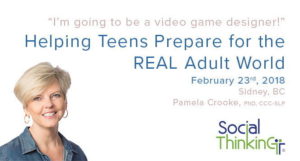
“I’m going to be a video game designer!”

Helping Teens Prepare for the REAL Adult World

February 23rd, 2018, Sidney
with Pamela Crooke, PhD, CC  C-SLP
Director, Social Thinking Training and Speakers’ Collaborative, San Jose, California

At ACT, we hear from many families concerned that their teens with ASD are unprepared to graduate. Academically able students also need help to develop the life skills they need to thrive in higher education and employment. School and home teams are more effective when they consider these issues at 12 rather than 17!

This one day workshop with Dr. Pamela Crooke, who works extensively with able teens and young adults, will provide school teams and parents with a practical approach to helping young people with ASD thrive either in higher education or employment.

Event Details & Registration

Faster than a Speeding Bullet:

iPads in Autism Intervention

March 10th, 2018, Vancouver
with Dr. Brenda Fossett

Since the iPad was first released in 2010, the use of iPads and other tablets have become common learning tool in the educational environment. For individuals with autism and other developmental disabilities, they have been seen as “miracle” devices. However, for these devices to be effective, there is a lot to be considered.

This workshop will review a number of skill areas in which the iPad can be a useful instructional tool and/or an aid for daily living. Current research regarding the effectiveness of iPad and other tablet-based applications in a variety of skill areas, including communication, academic, daily living, social and employment skills will be reviewed.

Relevant apps will be discussed and/or demonstrated. This presentation will address the age range, from young children to adult. It is aimed at those who need considerable support in communication and behaviour.

Event Details & Registration

Parents can Register for this and any other ACT Event for $25 a day:

Visit any ACT Event and choose
“Parent of Child with ASD” when you add to cart

Bursaries for those most in need, including para-professionals, parents who have children with special needs other than autism, adults with ASD, and professionals who need to travel outside of their home regions are also available, to the best of our financial ability. We will also be providing reduced registration fees to attend our web streamed events. For information on how to apply for an ACT bursary, please visit the Bursaries FAQ page


We’ve moved!

Our new office is located at
204 – 2735 East Hastings Street, Vancouver

Our phone number and other contact information are unchanged.


New BC Resources and
Autism Information portals

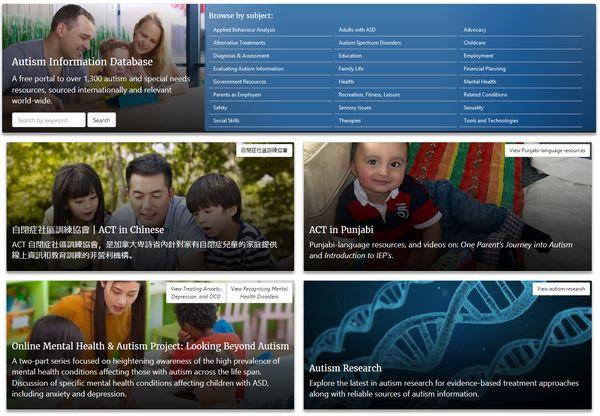
Our recently re-designed portals to Autism Information and BC Resources are now available. These pages make it easier than ever to discover ACT’s autism resources, community events, and information in multiple languages.

BC Resources

Search B.C. Community Resources, find Community Events, look through the Autism Manual and New Diagnosis Hub, discover educational opportunities, and much more.

Visit B.C. Resources


Autism Information

Search the Autism Information Database (AID), browse by subject, find autism information in Chinese and Punjabi, along with dozens of languages in the AID, browse videos in the Online Mental Health and Autism Project, and discover the latest in autism research.

Visit Autism Information


Autism in the News

Get the latest on our Facebook page

Parents Are Making Their Children Drink Bleach to ‘Cure’ Them of Autism – Newsweek

Finally, a Sensitive Portrayal of Both Autistic Women and Star Trek Fans – Slate

Skirting the wait list, Edmonton schools aim to diagnose autism on their own – Edmonton Journal

Weighing up autism’s obesity crisis – Spectrum News

Drawings connect autistic student with the world – Salmon Arm Observer

How David Bowie helped my autistic son become himself – Slate

Brentley’s journey with autism: A three-year-old Penticton boy has a new direction in life – Pentiction Western News

Edmonton schools cope with explosion in number of students on autism spectrum – Edmonton Journal

Another rug bites the dust: A mom laments the collateral damage of autism – Autism Society San Francisco Bay Area

Sensory sensitivity may share genetic roots with autism – Spectrum News

Lake Nona hospital creates special room in ER for autistic children – WFTV

Autism advocate launches ‘prescription television’ show – Philadelphia Tribune

Girls with autism need help honing social skills in realistic settings – Spectrum News

Professor put on leave after allegedly mocking U of G student with ‘severe anxiety‘ – CBC News

Garda probe into alleged threat to ‘bash the autism out of’ mum’s children – Herald News

France faces down its outdated notions about autism – Spectrum News

Nonverbal Canadian woman appears on ‘Late Show,’ turns tables on Colbert – CTV News

Mom who quit job to care for son with autism questions Trudeau about national ‘crisis’ – CTV News

New measure yields rapid diagnosis in adults with autism – Spectrum News